Le LAMA
Unité Mixte de Recherche 5127 CNRS — Université Savoie Mont Blanc
Membre du pôle MSTIC
Membre de la fédération de recherche MARA
Institut des Mathématiques pour la Planète Terre
Charte éco-responsable votée le 5 Décembre 2019 en Assemblée Générale


Événements marquants
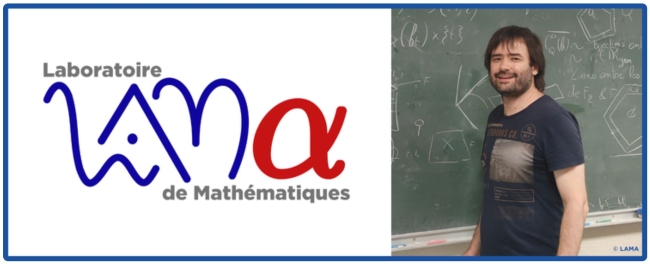
Félicitations à Sébastien Tavenas, CR CNRS au LAMA, qui est lauréat avec 2 autres collègues de l'appel à projet ERC Synergy 2026 !
D’une durée de 6 ans et d’un montant maximal de 10 millions d’euros , ces bourses sont conçues pour permettre à des groupes de 2 à 4 scientifiques, de pays membres ou associés, de « s’attaquer à certains des problèmes de recherche les plus redoutables du monde, qui couvrent plusieurs disciplines scientifiques ».
L'équipe lauréate :
VePaSS – avec Mahsa SHIRMOHAMMADI (CNRS/Université Paris Cité) – CNRS Sciences Informatiques, Véronique CORTIER (CNRS/Université de Lorraine) – CNRS Sciences Informatiques et Sébastien TAVENAS (CNRS/Université Savoie Mont Blanc) – CNRS Mathématiques
Dernières actualités
Soutenance de thèse de Mme MUSTATEA Sorina le 10 semptembre 2026 à 09H00.
Sujet de thèse: Méthodologie de détection de défauts dans les systèmes photovoltaïques par des approches Machine Learning
Fault Detection Methodology for Photovoltaic Systems Using Machine Learning Approaches
Unité de recherche : LAMA
Lieu de la soutenance: L’amphithéâtre du bât.3 Pôle - USMB : L’amphithéâtre du bât.3 Pôle Montagne - Bd de la Mer Caspienne, 73370 Le Bourget-du-Lac
Résumé ici. (téléchargeabla avant le 26/09)
Soutenance de thèse de Srijani MUKHERJEE le 09 septembre 2026 à 14h.
Sujet de thèse: Diagnostic avancé des installations photovoltaïques par fusion de données et traitement d'images.
Advanced diagnostics of photovoltaic plants using data fusion and image processing.
Unité de recherche : LAMA, directeur de thèse Laurent Vuillon
Lieu de la soutenance: Campus scientifique Technolac - Bâtiment Chablais - salle TLR - 73370 Le Bourget du Lac.
Résumé ici (téléchargeable avant le 20/09/2026)
Soutenance de thèse de Téofil ADAMSKI le 08 juillet 2026 à 16h.
Sujet de thèse: Analyse microlocale non archimédienne : formule de la phase stationnaire et noyaux de distributions.
Non-Archimedean microlocal analysis: stationary phase formula and kernels of distributions.
Unité de recherche :LAMA
Lieu de la soutenance: Bâtiment Chablais (bât. 21) - salle TLR - Campus scientifique - 73730 Le Bourget du Lac.
Mots-clés : intégration motivique, analyse microlocale, analyse non archimédienne, distributions, noyaux, intégrales oscillantes
Résumé :
Issue de l'analyse de Fourier, l'analyse microlocale est une branche de l'analyse en mathématiques où l'on travaille avec des variables d'espace $x$ et de fréquence $xi$. Cette théorie a été introduite en 1970, indépendamment par Sato et Hörmander, et associe à une distribution $u$ sur $RR^n$ une partie de $RR^n times (RR^n setminus {0})$ que l'on appelle front d'ondes de cette distribution et qui mesure son défaut de lissité. L'objectif de cette thèse consiste à poursuivre des travaux récents sur l'analyse harmonique et sur les fronts d'ondes de distributions dans les contextes non archimédiens, par exemple $p$-adique et motivique sur le corps $CCls t$. Ainsi, dans
une première partie, nous étudions la méthode de la phase stationnaire pour les intégrales oscillantes à phase non dégénérée dans le contexte $p$-adique et nous la généralisons au cadre~$t$-adique à l'aide de l'intégration motivique de Cluckers--Loeser. Dans une seconde partie, nous démontrons un théorème de représentation, dit des noyaux de Schwartz, pour les distributions $p$-adiques et motiviques définies sur un espace produit et, par analogie avec un théorème d'Hörmander dans le cadre réel, nous étudions les liens entre le front d'ondes d'une distribution et ceux induits par son noyau.
Soutenance de thèse de Noura AL AKKARI le 10 juillet 2026.
Lieu: Amphithéâtre « Revard », Bâtiment 1, USMB, Site Bourget-du-Lac.
Elle s'intitule "Décomposition empirique supervisée des signaux temporels de consommation électrique".
Langue : La soutenance de la thèse se déroulera en anglais
Résumé : This research focuses on improving household resource management through advanced disaggregation techniques that separate overall water and electricity consumption into individual appliance-level usage. The primary objective is to design generalized models capable of identifying appliances regardless of brand or specific design, while taking into account the operational constraints of a typical household.
The first part of the study addresses electrical disaggregation. Using real-world consumption data, a method based on event detection and mathematical modeling was developed to represent appliance behavior. Two identification strategies were introduced, depending on the complexity of the detected events. The results showed improved accuracy compared to traditional methods such as Hidden Markov Models (HMMs).
The second part explores water disaggregation from an optimization perspective, framing the problem as a binary knapsack challenge. Each peak in water flow is treated as the outcome of an optimal combination of appliances, selected under flowrate constraints. Despite being unsupervised, this approach performed comparably to supervised models like Support Vector Machines (SVM), demonstrating strong potential for generalization and real-world application.
The third section proposes a combined approach to water and electricity disaggregation, using a genetic algorithm to optimize appliance selection under simultaneous constraints of power and flowrate. This dual-layered method offers a more integrated understanding of household consumption patterns and helps identify optimal usage scenarios based on user habits and system limits.
Overall, this work contributes to the development of intelligent monitoring systems that can support more informed and sustainable resource use. It also highlights key challenges such as variability in user behavior, data privacy concerns, and scalability. Future directions include incorporating time-based and behavioral features, improving model flexibility, and ensuring broader applicability across diverse household environments.
Nom | Role | Organisation |
Romain Bourdais | Rapporteur | Centrale Supelec |
Laurent Deroussi | Rapporteur | Université Blaise Pascal |
Khalil El Khoury | Examinateur | Université du Liban |
Monika Woloszyn | Examinatrice | Université Savoie Mont-Blanc |
Laurent Vuillon | Examinateur | Université Savoie Mont-Blanc |
Sylvain Lespinats | Directeur de thèse | CEA/INES, France |
Aurélie Foucquier | Co-encadrante | CEA/INES, France |
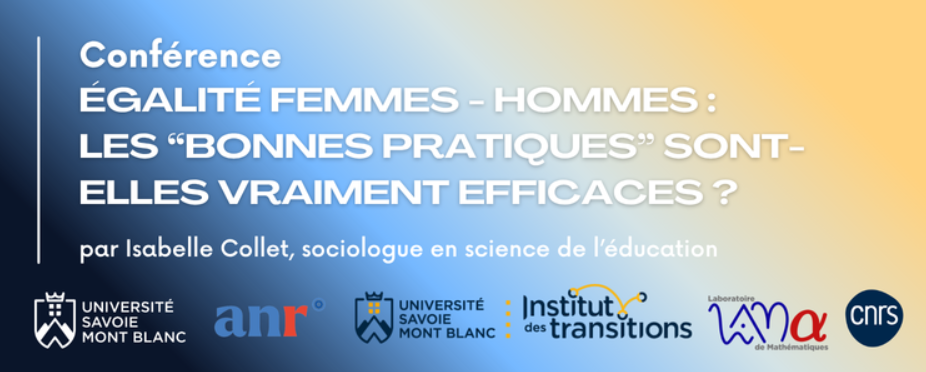
Le comité parité du LAMA a le plaisir de vous inviter à la conférence
Égalité Femmes-Hommes, les "bonnes pratiques" sont-elles vraiment efficaces ?
présentée par Isabelle Collet. Informaticienne de formation, Isabelle Collet est sociologue, professeure en sciences de l’éducation à l’université de Genève et spécialisée dans les sciences de l’éducation et dans les études de genre.
Cette conférence sur la place des femmes dans les sciences aura lieu le lundi 08 juin à 10h30 en amphi Polytech C002 à Savoie Technolac. Elle sera suivie d'un buffet afin de prolonger les échanges.
En savoir plus :
- La conférence est gratuite et ouverte à toutes et à tous sans inscription.
- La participation au buffet qui suivra le conférence est également gratuite mais nécessite en revanche une inscription : [s'inscrire ici]
- Contacts : Céline Labart et Laure Bastide, membres du comité parité du LAMA
Présentation
Le LAMA (Laboratoire de Mathématiques de l'Université Savoie Mont Blanc) existe depuis la création de l'Université de Savoie en 1979. Il est une unité mixte de recherche CNRS (UMR) depuis janvier 2001.
Il est organisé autour de trois équipes de recherche :
Cette diversité de thèmes de recherche dans un seul laboratoire est l'expression de l'unité des mathématiques dans ses trois composantes : mathématiques pures, mathématiques appliquées et mathématiques et informatique. Notre dénominateur commun est d'une part, la qualité de la recherche fondamentale, et, d'autre part, le souci des applications, même si ce mot est à prendre différemment selon les équipes. Il s'agit en effet des applications dans d'autres sciences (géophysique, physique, biologie, mécanique et informatique) ou dans d'autres domaines des mathématiques (géométrie appliquée en théorie du contrôle…) ou encore dans le domaine de la pédagogie. Cela exprime l'ouverture des mathématiques vers le monde scientifique extérieur et notre effort constant en faveur des recherches pluridisciplinaires.
Vous pouvez télécharger
Il est à noter que le LAMA dispose d'une bibliothèque, enrichie régulièrement en ouvrages mathématiques, et d'une salle de séminaire : la salle TLR, du nom de Thomas LACHAND-ROBERT (ancien professeur du laboratoire, disparu prématurément en 2006 : on peut consulter l'hommage qui lui a été rendu dans ce document) d'une capacité de 30 places assises.
Séminaires
-
Séminaires d'équipe, hebdomadaires:
-
Autres séminaires :
- Séminaire du laboratoire.
- Séminaire des doctorants.
- Séminaire CMI: il accueille un chercheur qui vient présenter sa recherche aux étudiants suivants le Cursus Master Ingénieur (CMI).
- Séminaires des laboratoires de la fédération de recherche en Mathématiques (MARA) :
- Institut Camille Jordan
- Institut Fourier
- Laboratoire de Mathématiques : Séminaire de Mathématiques Pures et Séminaire de Mathématiques Appliquées
- Laboratoire Jean Kuntzmann
- Unité de Mathématiques Pures et Appliquées
Valeurs
Charte éco-responsable
Le laboratoire a voté en Assemblée Générale un ensemble de pratiques, concernant ses activités de recherche, visant à réduire son impact environnemental dans le cadre professionnel. Cette réflexion s'inscrit dans celle menée par le CNRS et par le collectif national Labos1point5 et ses initiatives locales à l'USMB et à Grenoble. Ce texte peut être consulté ici.
Parité - égalité en recherche mathématique
En lien avec les politiques de nos tutelles, le comité Parité du LAMA est attaché à l'égalité des chances entre les femmes et les hommes et agit pour la sensibilisation aux questions de discriminations envers les femmes au sein de la communauté mathématique. Le comité travaille à la diffusion de l'information sur le sujet, ainsi qu'à l'organisation d'interventions en lycées.
- CNRS : Mission Pour la place des femmes.
- INSMI : les questions de parité et égalité en recherche mathématique.
- Université Savoie Mont Blanc : égalité et diversité professionnelle.
Gratification des stages
Dans le cadre des stages de M2 au LAMA, le laboratoire peut prendre en charge une partie de votre hébergement et/ou transport. Valable pour les étudiants non inscrits à l'USMB. Hébergement au CROUS du Bourget-du-Lac pendant la durée du stage, un aller-retour en avion ou train.
Accès
Situation
Le laboratoire de Mathématiques se trouve sur le site de Savoie-Technolac, près du lac du Bourget, à proximité de Chambéry et Aix-les-bains.
-

- Situation du campus
-

- Campus scientifique de Savoie Technolac (photothèque USMB)

Une fois parvenu sur le site, on trouvera le laboratoire au bâtiment « Le Chablais » correspondant au numéro 21 sur les plans (plan ci-dessus et voir également sur le plan du campus ou sur OpenStreetMap.

Pour voir la liste et le nom des arrêts du bus desservant le campus, merci de cliquer sur le plan ci-dessus.
Nos hôtes sont habituellement logés dans le centre-ville. Ils peuvent rejoindre le campus en 30 minutes environ par le bus A (direct) direction « Technolac INSEEC » ou « Bourget Plage » : plan du centre de Chambéry.
En bus (à partir de Chambéry)
Prendre la ligne A (direct) direction « Technolac-INSEEC » depuis le centre ville (arret à la gare SNCF) et descendre à l'arrêt « Université le Bourget ». Vous pouvez consulter les horaires sur le site de Synchro Bus, ainsi que l'ensemble des plans du réseau.
En train
Les gares de Chambéry et d'Aix-les-Bains sont très bien desservies par le TGV (pas forcément les mêmes trains).
À partir de la gare de Chambéry, prendre le bus (ligne A, voir plus bas) ou attendre que l'on vienne vous chercher.
Il existe aussi des bus partant de la gare d'Aix-les-Bains (ligne 1), mais ils sont peu nombreux (tél 04 79 88 80 60 ou le site d'Ondea.
En avion
L'aéroport de Chambéry est tout près du campus, mais il y a peu de vols.
Le plus simple est d'arriver par l'aéroport de Lyon Saint Exupéry.
À partir de l'aéroport, prendre une navette (bus) en direction de Chambéry, Aix-les-Bains ou direction Lyon et connexion par train.
Une autre possibilité est d'utiliser l'aéroport international de Genève qui a de nombreux vols (y compris low-cost). Il est possible ensuite de rejoindre Chambéry ou Aix-les-bains par train ou bus. Voir les informations sur le site de l'aéroport sur ce lien.
En voiture
En venant de Lyon, prendre l'autoroute A43 en direction de Chambéry. Après la sortie « Chambéry » prendre la direction « Le Bourget du Lac, Savoie-Technolac » (voir plan d'accès autoroutier).

En venant de Grenoble ou Turin, prendre l'autoroute A41 en direction de Chambéry. Après la fin de l'autoroute, continuer sur la voie rapide vers Aix-les-bains, et prendre la sortie « Le Bourget du Lac, Savoie-Technolac » (voir plan d'accès autoroutier).
En venant d'Annecy ou Genève, prendre l'autoroute A41 en direction de Chambéry. Après la fin de l'autoroute, prendre la sortie « Le Bourget du Lac, Savoie-Technolac » (voir plan d'accès autoroutier).
Coordonnées
- Tutelles : Université Savoie Mont Blanc et CNRS (UMR 5127)
- UFR de rattachement : Sciences et Montagne
- Directeur : Dorin Bucur
- Responsable administrative : Laure Bastide
- Gestionnaire : Fernanda Mendonca Dos Reis
- Adresse postale : Bâtiment Le Chablais, Campus Scientifique, 73376 Le Bourget du Lac, France
- Téléphone (secrétariat) : (+33/0) 4 79 75 87 17

